My recipe for today is pol roti and sambol, which is a quintessential Sri Lankan breakfast. The Sri Lankan roti’s uniqueness stems from the addition of grated coconut to the dough.
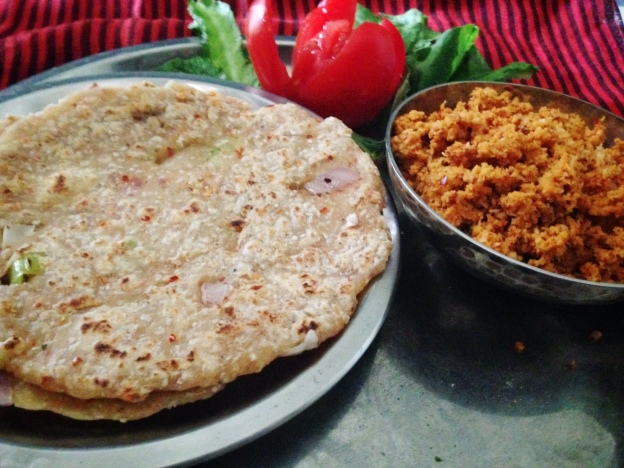
In my house, it has been a favourite meal across generations. One of my mother’s favourite childhood memories is that of her mother making roti for their tea on rainy days. My grandmother apparently added her own twist to the coconut roti, by adding chopped chilli and onions, making it a spicy roti which she served with plain tea. As it was an occasional treat reserved for rainy days, my mother and her siblings came to regard it as a favourite food and a special treat. They passed on this partiality to my generation and my cousins, siblings and I all seem to share this preference for roti and sambal. It is not breakfast food at home though, but a dinner meal. Apparently, the tiniest member of our family, my two year old niece, has also acquired this preference for roti after having her first little bite of roti this month.
Katy of Untold Morsels recently asked me what comfort food I made that reminded me most of home. I immediately thought of pol roti and sambol and then I realized that I was yet to share the recipe of pol roti on this blog. So, I decided to remedy the situation immediately with this post.
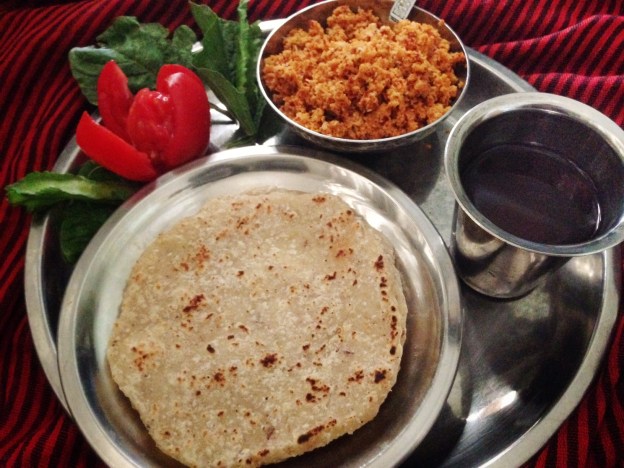
Do try making the Sri Lankan pol roti and sambol at home! You will surely enjoy the treat!
Pol Roti and Pol Sambol
Ingredients:
Roti:
- Flour – ¾ cup
- Coconut – ½ cup, freshly grated
- Salt, to taste
- Little water
- Oil – 1 tbsp
- For spicy version of roti:
- Atta flour – ¼ cup
- Green chillies and onions – 1 or 2 tbsp, chopped
- Crushed chilli flakes
Pol Sambol:
- Coconut – ¾ cup
- Red chillies – 5 or 6
- Onion – ½
- Curry leaves
- Salt, to taste
Method
- Sift the flour and add the salt and grated coconut.
- For the spicy roti version, add the atta flour, chopped green chillies and onions and crushed chilli flakes as well to the flour mix. My mother loves the spicy roti while I prefer it without the chopped onions.
- Add a little water to the flour mix and make a dough.
- Add a tbsp of oil at the end so that the dough does not stick.
- Divide the dough into 3 or 4 balls and keep aside for 5 – 10 mins.
- Heat the flat pan.
- Flatten each ball and cook it over low heat, on the flat pan. Ensure it sufficiently browns on both sides by flipping it.
- Prepare the sambol by lightly frying the chopped chillies, onion and curry leaves and then grinding it with grated coconut and salt.
- Serve immediately with warm rotis and a cup of Sri Lankan tea.
Recipe source: Raji Thillainathan.


 Today’s music feature is on the Carnatic progressive rock band, Agam, which is based in Bangalore. While the band has been around for a decade or so, I only heard their music when they played at the MTV Coke Studio. ‘Malhar Jam’ is the clip that introduced me to their music.
 Given that I have been listening to mostly Sufi songs this week, I decided to share another Sufi song that I enjoyed listening to. This clip is also from MTV Coke Studio’s YouTube channel. The musicians are Ustad Raees Khan (sitar) and Abida Parveen.
 I’d like to share a song that I came across on the Coke studio youtube channel and which I enjoyed very much. This song is an adaptation of a poem by the 13th century mystic poet, Amir Khusrow, who is also regarded as the father of qawwali. Here, it is sung by two contemporary famous qawwali musicians – Abida Parveen and Rahet Fateh Ali Khan.
 Given that I watched a few Bollywood movies this january, my song choice for this weekend is one from Imtiaz Ali’s movie Tamasha, starring Ranbir Kapoor and Deepika Padukone. The lyrics of the song was written by Irshad Kamil and music composed by A.R.Rahman and sung by Mohit Chauhan.
 A Taste of Sri Lankan cuisine