Radish curry

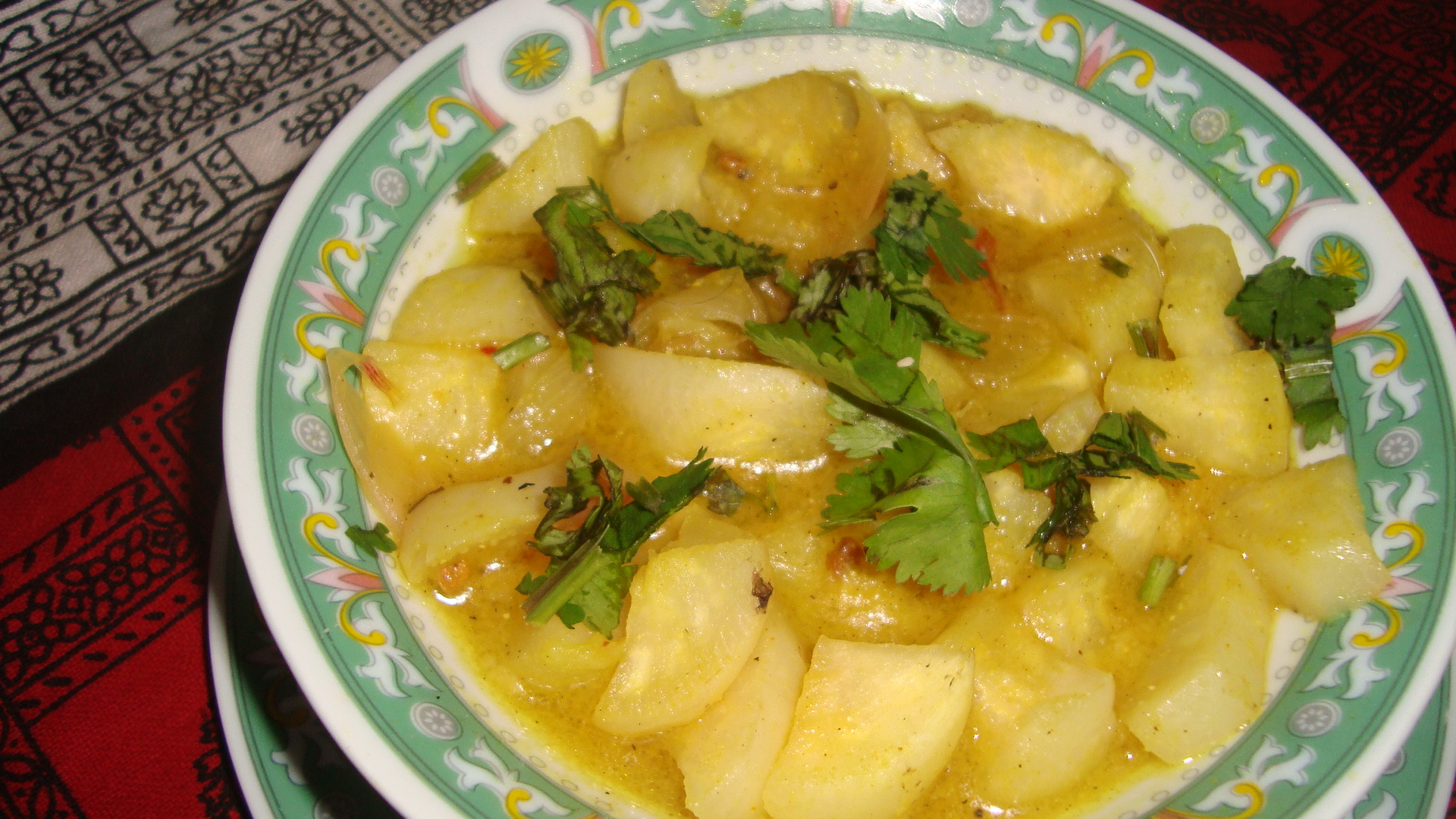
I have never really liked radish as I do not like its smell. However, occasionally, it is cooked at home and this is a recipe of my mother’s that makes eating radish tolerable for even those who dislike it. Radish is supposedly good for lowering cholesterol and fighting cancer.

Radish curry

Time taken: 15 – 20 mins

Serves 4

Radish curryIngredients:

  • Radish/ Mullangi – 1
  • Onion – ¼, chopped
  • Green chilli – 1, chopped
  • Urad dhal – 1 tsp, roasted and ground
  • Pepper – ½ tsp
  • Turmeric powder (optional)
  • Low fat oil – 1 tbsp

Method

  1. Wash and peel the radish before chopping it into smaller pieces.
  2. Heat a tbsp. oil in a pan and sauté lightly the chopped onion and chilli.
  3. Then, add the chopped radish to the pan and mix well.
  4. Add 1 ½ cups of water to the pan and cook the radish for about 10 mins.
  5. If the water dries up, add another ½ cup of water.
  6. Add 1 tsp roasted and ground urad dhal and stir.
  7. Add pepper and optional turmeric powder. Mix well and cook for a couple of minutes before removing from stove.
  8. Serve with rice.

Recipe source: Raji Thillainathan.

Cabbage and carrot fry

Cabbage and carrot fry

Time taken: 25 mins

Serves 4

Cabbage and carrot fryIngredients:

  • Cabbage – 1 cup, shredded
  • Carrot – ½ cup, grated
  • Malu miris – ½
  • Onion – ½
  • Fennel – 1 tsp
  • Ginger – ½ “, chopped
  • Garlic – 2 or 3 cloves, chopped
  • Turmeric powder – ½ tsp
  • Scraped coconut – 1 tbsp
  • Crushed chillies – 1 tsp
  • Low fat oil – 1 tbsp

Method:

  1. Clean and wash the cabbage and add salt and turmeric to the shredded cabbage.
  2. Heat a tbsp oil in a pan and fry the chopped onion, ginger, garlic and fennel seeds for a couple of mins.
  3. Add the cabbage and carrot to the pan and stir fry for another 7 – 8 mins.
  4. Add the freshly scraped coconut, mixed with a pinch of turmeric, and crushed chillies. Stir fry for another 5 mins.
  5. Serve with rice.

Recipe source: Raji Thillainathan.

Passion fruit cake

Today is Vijayathasami. The tenth day after the nine days of the Navarathri festival. It is considered auspicious to start new learning on this morning. Children who will be starting school in the coming year will have their ‘eadu thodakkal’ ceremony. The ‘eadu thodakkal’ is a ceremony where toddlers trace their first alphabets on a tray of grain and is usually held at the temple with the priest conducting the ceremony. One of my friend’s twins will be starting their ‘eadu thodakkal’ today and I feel sorry for her as they are two energetic boys who can’t keep still for a minute and I hope that she manages to keep them engaged at least for the alphabet tracing part.

For Vijayathasami, we have never really done anything at home other than visit the temple. At the start of the Navarathri, both at the temple and in the home, people plant the seeds of nine varieties of grain (nava thaniam) such as moong dal, chickpeas, urad dhal, kurakkan etc. and on the tenth day, the sprouts are collected and placed before the shrine in the home. The sprouts are supposed to symbolize growth, luck and prosperity. As a child, I used to keep a few of the sprouts in the school book of the subject that I wanted better grades on.

Today’s recipe for Vijayathasami is a non-traditional one – the recipe for my mother’s passion fruit cake as we enjoy baking at home.

DSC00110Passion fruit cake

Time taken: 55 mins

Serves 6 to 8
Passion fruit cakeIngredients

  • Low fat margarine (Sunflower or Canola) – ¾ cup + 2 tbsp
  • White sugar – ¾ cup
  • Passion fruit – ½ cup
  • Yoghurt – ½ cup
  • Water – ½ cup
  • Wheat flour – 1 cup
  • Semolina – ½ cup
  • Baking soda – ½ tsp
  • Baking powder – 1 tsp
  • Rose essence – few drops
  • Icing sugar – 6 tbsp
  • Lemon juice – 1 tsp
  • Vanilla essence – few drops

Method:

  1. Whisk the sugar and margarine till creamy.
  2. Add ½ cup of water, passion fruit, yoghurt to the creamed sugar and margarine and blend for about 2 mins.
  3. Add ½ tsp baking soda and 1 tsp baking powder.
  4. Stir in the flour and semolina gradually.
  5. Add a few drops of rose essence.
  6. Transfer to baking tray and bake for 45 mins at 170⁰C/340⁰F.
  7. Remove from oven and let the cake cool while you prepare the icing.
  8. Whisk 2 tbsp margarine, 6 tbsp icing sugar, 1 tsp lemon juice until creamy. Add a few drops of vanilla essence.
  9. Spread the icing over the cake evenly.
  10. Serve immediately or chilled.

Recipe source: Raji Thillainathan.
Laddu

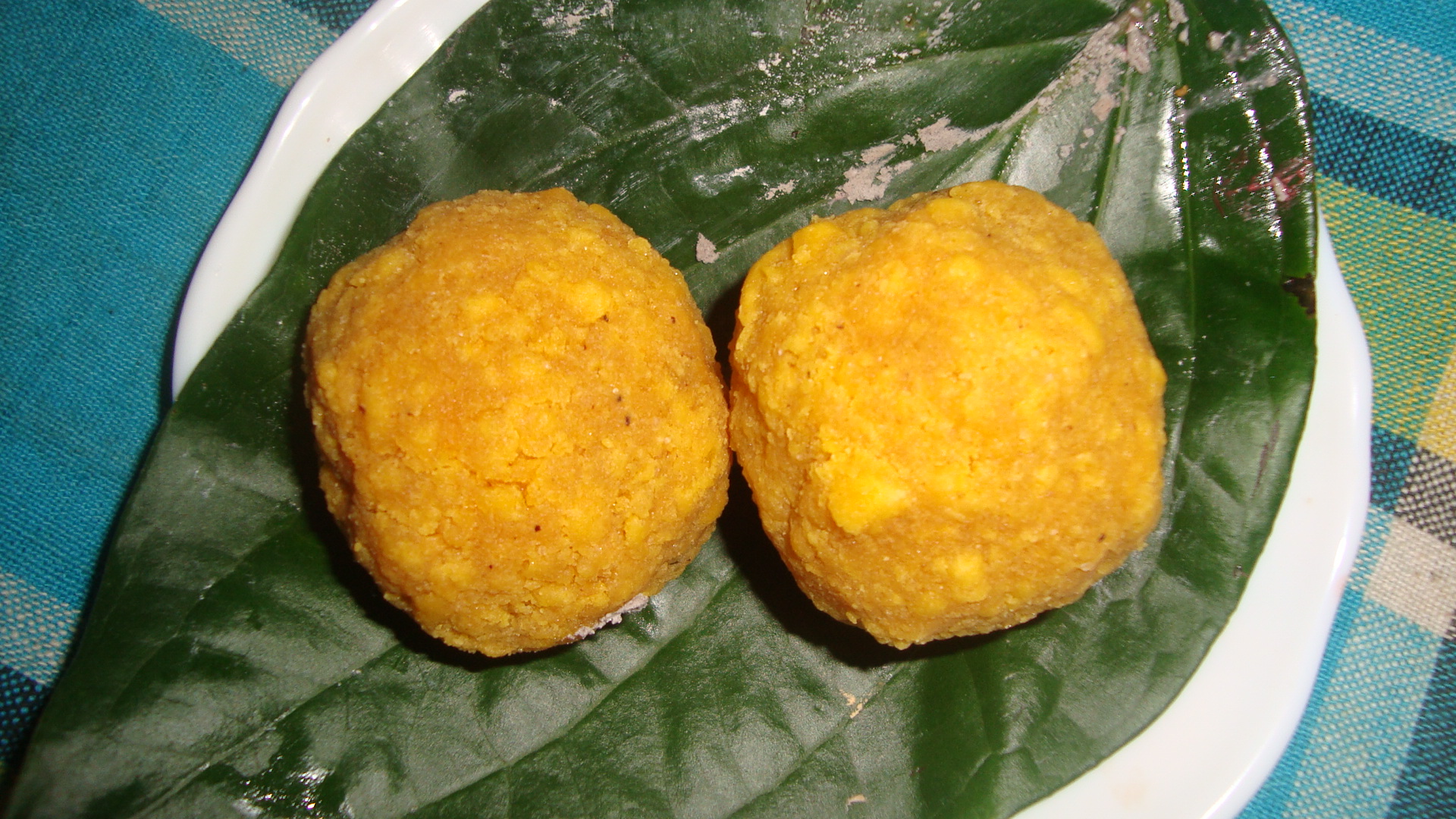
While the semolina laddu is more commonly made in homes in Sri Lanka, particularly in the north, I prefer the chickpeas flour laddu. I generally refer to that laddu as the ‘Thirupathi laddu’ as the best chickpeas flour laddu I have tasted to-date is the ‘prasadam’ from Andhra Pradesh’s famed Thirupathi temple.

We rarely make it at home as it is not easy to come by high quality chickpeas flour in most stores. As an amateur cook who only started taking an interest in cooking six months ago, it was not surprising that I burnt my laddu during my first attempt. I learnt that one has to be really quick during the roasting and mixing other ingredients part.

So, for today’s Navarathri festival recipe, I would like to share my mother’s recipe for the chickpea laddu. The accompanying photo is temporarily that of the photo I took of the Vajira Pillaiyar koyil ‘laddu’ and will be replaced when I take a photo of the laddu my mother makes later this week.

Laddu

Time taken: 15 – 20 mins

Makes 8 – 10

LadduIngredients:

  • Chickpeas flour – 1 cup
  • Sugar – ½ cup
  • Low fat vegetable oil margarine or ghee – ½ cup
  • Cardamoms – 4, crushed
  • Cashew nuts – 2 tbsp
  • Raisins – 2 tbsp
  • Sugar candy – 1 tbsp (optional)

Method:

  1. Roast the chickpeas flour over low heat, without allowing it to burn, for about 5 – 10 mins.
  2. Add crushed cardamom to the pan. Mix and remove pan from stove.
  3. Heat the sugar and margarine in another pan, over low heat, for around 5 mins.
  4. Stir in the chickpeas flour.
  5. Add the chopped cashew nut, raisins and the optional sugar candy quickly. Do not allow flour to burn.
  6. Add 4 tbsp of hot water. Mix well and remove pan from stove.
  7. Using hand, quickly divide mixture into 8 – 10 smaller balls.
  8. Allow ‘laddu’ to cool and firm, before serving.

Recipe source: Raji Thillainathan.

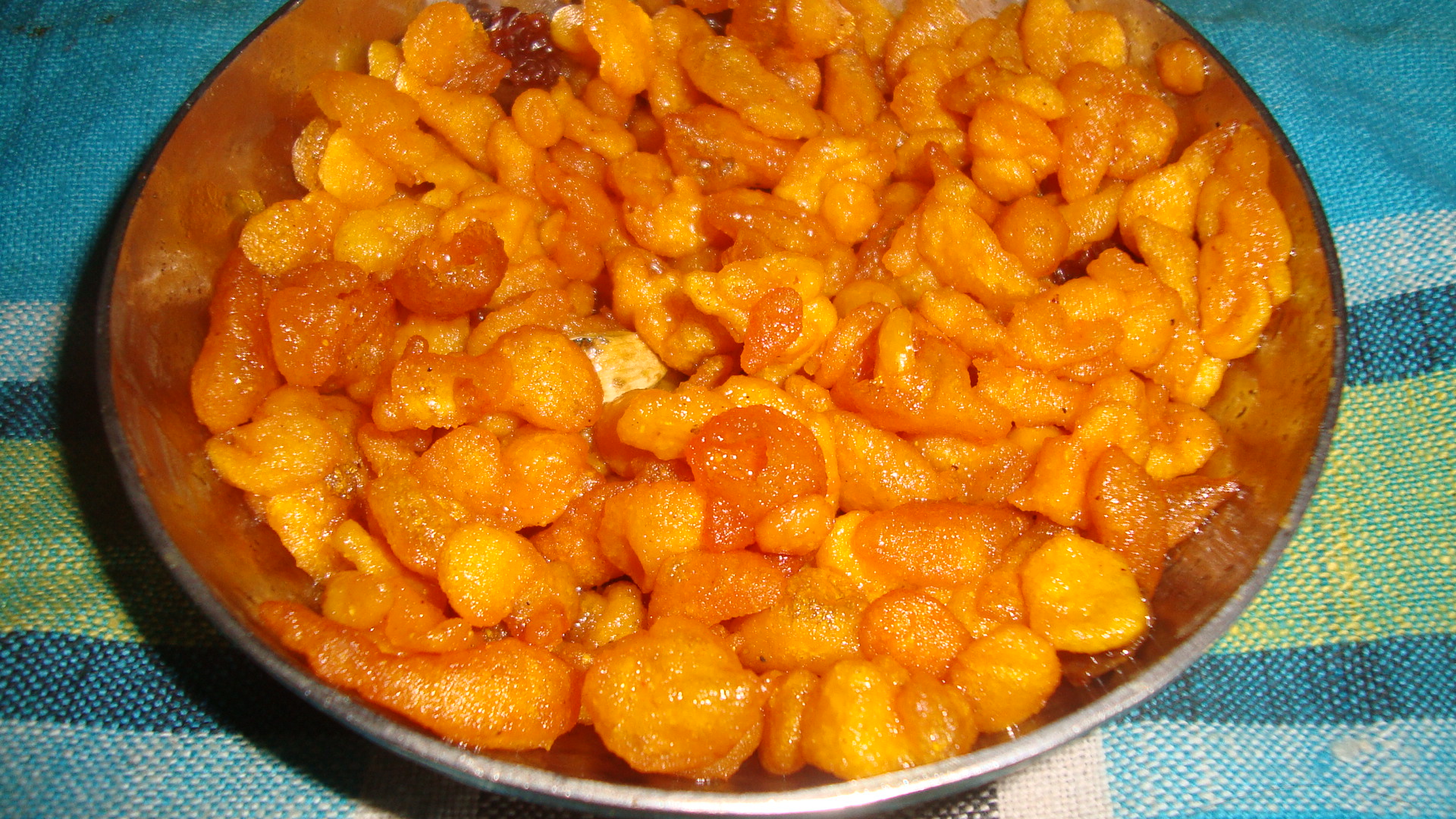
Boondi

Today’s Navarathri recipe is Boondi, a fried chickpea flour sweet that is quite popular in Sri Lanka and available in Indian sweet shops. As I like it and I do not like the too sugary consistency of shop-bought boondi, my mother occasionally makes it at home. This is my mother’s recipe for boondi.

Boondi

Time taken: 25 mins

Serves 2

BoondiIngredients:

  • Chickpea flour – 2 tbsp
  • Wheat flour – 2 tbsp
  • Salt, to taste
  • Vanilla essence – few drops
  • Kesari powder – pinch
  • Sugar – 4 tbsp
  • Cardamom – 2 or 3, crushed
  • Rose essence – few drops
  • Cashewnuts – 2 or 3, chopped
  • Raisins – 1 tsp
  • Chickpea – 1 tsp, fried and split
  • Low fat vegetable oil, for deep frying

Method

  1. Mix the chickpea flour, wheat flour, salt, few drops of vanilla essence, pinch of kesari powder with a little water in bowl to make a batter. The consistency of the batter should not be watery nor too thick but fluid enough to be scooped easily with a spoon.
  2. Heat the oil in a pan.
  3. When the oil is heated and ready for frying, scoop the batter with a spoon and push it through a slotted spoon over the pan so that the batter falls through in little pieces into the oil.
  4. Ensure that the boondi pieces are golden brown all over before transferring them out of a pan onto a plate lined with grease absorbing paper. Repeat until all the batter is transformed to fried boondi.
  5. Make the syrup for the boondi by stirring the sugar with ¼ cup of water in a saucepan on medium heat. Add the crushed cardamom, kesari powder.
  6. When the syrup starts thickening slightly, add a few drops of rose essence and remove from heat.
  7. Add the chopped cashewnuts, fried and split chickpeas and raisins to the syrup.
  8. Transfer the fried boondi to the syrup. Let it soak for some time before serving.

Recipe source: Raji Thillainathan.

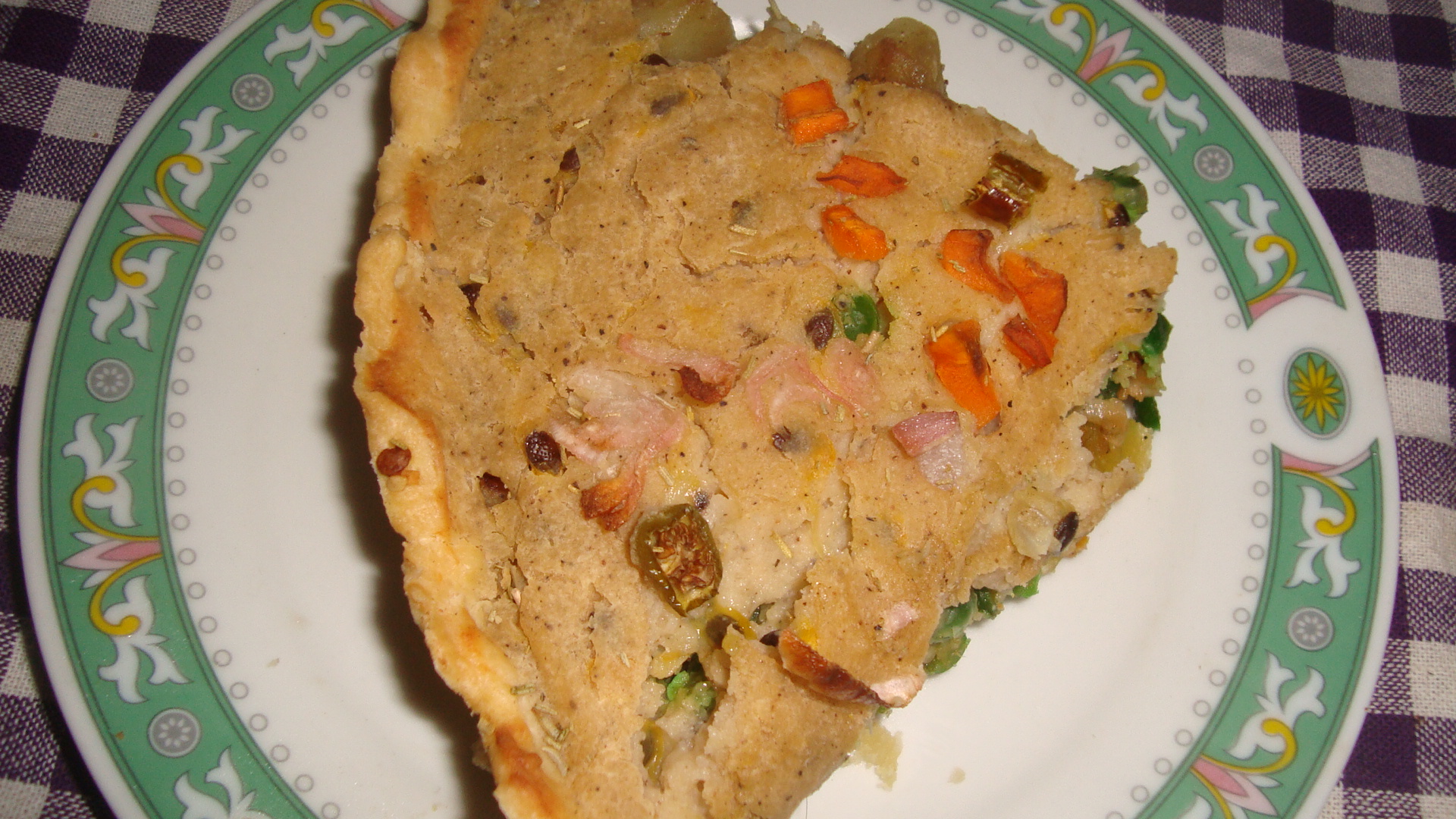
Savoury vegan pie

The recipe I would like to share today is the recipe for a pie that my mother made recently. It was delicious and very filling and included lots of vegetables and even passion fruit and peanuts.

A slice of pieSavoury vegan pie

Time taken:  1 ½ hours

Serves 6 or 8

Ingredients:

Base:

  • Wheat flour – 1 cup
  • Vegetable oil margarine – ¼ cup
  • Salt, to taste

Filling:

  • Green peas – ¾ cup
  • Carrot – ½ cup, chopped and grated
  • Tomatoes – ¾ cup
  • Cabbage – 2 tbsp, shredded
  • Potatoes – 1 or 2
  • Onion – ½
  • Chilli – 1
  • Crushed peanuts – 1 tbsp
  • Ginger – ½ or 1″, as per taste
  • Garlic – 3 or 4 cloves
  • Pepper and salt, to taste
  • Low fat oil (sunflower or canola) – 2 tbsp

Top layer:

  • Soya milk – 1 cup
  • Urad dhal/ Ulunthu flour – 2 tbsp
  • Wheat flour – 1 tbsp
  • Passion fruit – 1
  • Rosemary – 1 tsp
  • Sesame seeds – 1 tsp
  • Chilli or capsicum – 1
  • Onion – ¼
  • Salt and pepper, to taste

Method:

  1. Make the dough for the pie base by mixing the wheat flour, margarine and salt, to taste and kneading it. Let the dough rest while making the filling for the pie.
  2. Boil the tomatoes and mash them slightly. Boil the potatoes and cabbage.
  3. Heat 2 tbsp oil in a pan and fry the ginger and garlic. Then add the onion and crushed peanuts and fry for a few minutes.
  4. Add the slightly mashed, boiled tomatoes to the pan and then add the carrots followed by the green peas and finally the potatoes and cabbage.
  5. Add pepper and salt, to taste. Keep aside the vegetable filling.
  6. In a saucepan, heat the soya milk with 2 tbsp urad dhal and 1 tbsp wheat flour. Bring to a boil, adding salt and pepper, to taste.
  7. When the sauce begins to thicken, add the pulp of passion fruit to give the mix a tangy and fruity flavour.
  8. Take the pie pan and roll out the pie base, covering the pan.
  9. Spoon the vegetable filling on top of the pie base and level it smoothly across the pan.
  10. Pour the tangy batter-like sauce over the vegetable filling.
  11. Sprinkle chopped onion, capsicum or green chilli and the rosemary and sesame seeds over the sauce covering the pie.
  12. Bake for 30 – 40 mins at 220⁰C/ 428⁰F.
  13. Serve hot with some spicy chutney or sauce.

Recipe source: Raji Thillainathan.

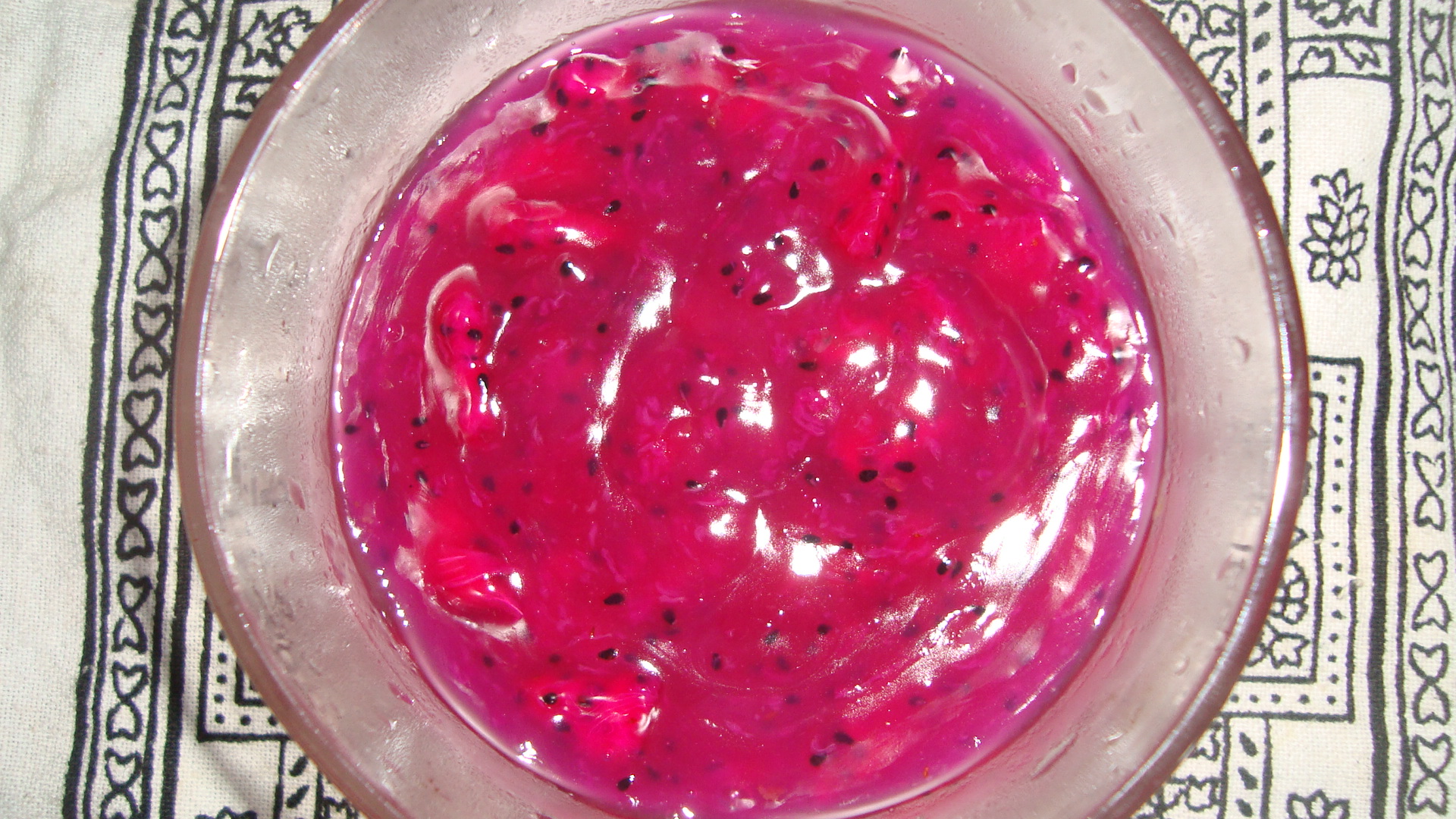
Dragon fruit pudding

With dragon fruits in season and because my mother and I like the fruit, we both decided to make a dessert using the fruit. So, here’s the recipe for the dragon fruit pudding that my mother made.

I had attempted to make a vegan red velvet cake using dragon fruit pulp as both an egg substitute as well as a source of natural red colouring but the cocoa powder in the batter simply overruled the rich red colour of the fruit. I will try the recipe once more with some adjustments and see if it works out.

My next post on the blog will be in October as I will be travelling and will not have access to my recipe base.

Dragon fruit pudding

Time taken: 5 mins

Serves 2

Dragon fruit pudding

Ingredients:

  • Dragon fruit – ½ cup, chopped
  • Corn starch – 2 tbsp
  • Water – ½ cup
  • Sugar – 1 tbsp + 1 tsp
  • Rose essence – few drops
  • Lime juice – 1 tsp

Method:

  1. Put the chopped dragon fruit and water in a sauce pan. Mash it coarsely with a spoon.
  2. Add a few drops of rose essence to the pan and mix well.
  3. Add the corn starch to the pan and stir.
  4. Cook on low heat for about 3 minutes, stirring continuously. The mixture will start to thicken.
  5. Remove from heat. Transfer the pudding to a bowl and let it cool.
  6. Mix 1 tsp lime juice and 1 tsp sugar and drizzle on top.
  7. The pudding can be served warm or chilled.

Recipe source: Raji Thillainathan.

‘Ayurvedic’ salad

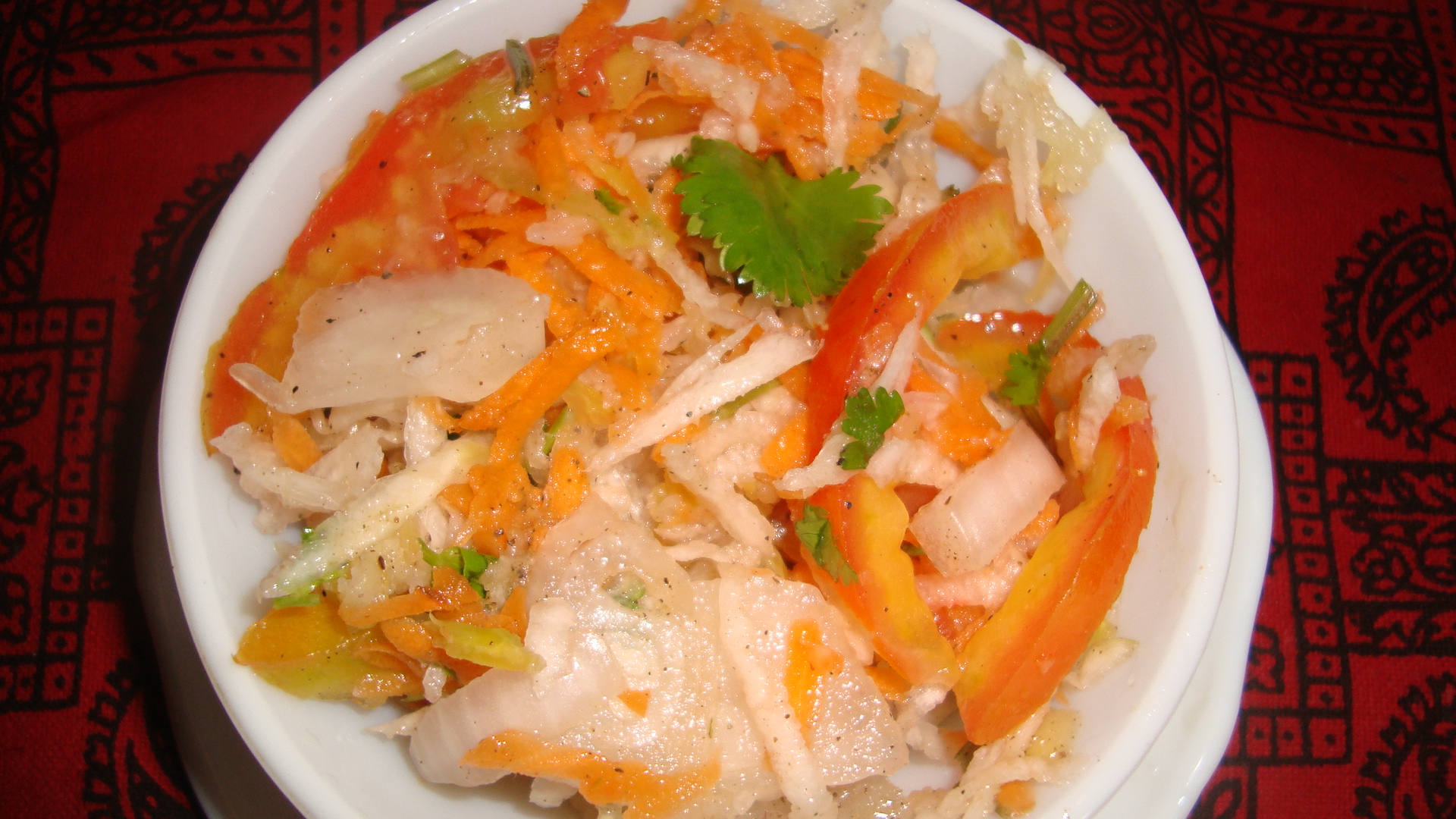
Today, I will share what my mother calls her ‘Ayurvedic’ salad because of the vegetables she uses in it. This salad is particularly good for regulating your sugar and cholesterol levels. I like it because it is colourful and crunchy and combines a vegetable I don’t like so much – radish – in  a more appetising way.

‘Ayurvedic’ salad

Time taken: 5 – 10 mins

Serves 2

Ayurvedic salad

Ingredients:

  • Radish – 3 tbsp, grated
  • Bitter gourd – 2 tbsp, grated
  • Tomato – 2 tbsp, finely chopped
  • Onion – 3 tbsp, finely chopped
  • Carrot – 2 tbsp, grated
  • Coriander – a few leaves, for garnish
  • Salt and pepper, to taste
  • Lime juice, to taste

Method:

  1. Place the salad ingredients – grated radish, bitter gourd, carrot and the chopped onion and tomato – in a bowl.
  2. Season with salt and pepper, to taste. Toss to combine.
  3. Garnish with coriander and drizzle some lime juice over the salad.

Recipe source: Raji Thillainathan.

Hoppers

Hopper (Appam/Appa) is a dish made in every corner of Sri Lanka. From street vendors to homes, it is one of the most popular dinner meals served around the country. In our house, my mother finds it the most frustrating dish to make as she has her good hopper days when she is proud of her creations and her bad hopper days when she faults her temperamental “hopper” pan. Today, I will share my mother’s recipe for her hopper batter.

Appam/ Appa

Cooking time: 30 mins + preparation time: 6 hours

Makes 12

Hoppers

Ingredients:

  • Raw rice – 1 cup
  • Bread – 2”x1” piece
  • King Coconut or plain Coconut water – ¼ cup
  • Wheat flour – 1 tbsp
  • Freshly scraped coconut – 1 tbsp
  • Water – 1 cup
  • Salt – ¼ tsp
  • Sugar – 1 tsp
  • Baking powder – 1 tsp

Method:

  1. Soak the rice in water for 3 hours. Simultaneously, soak the bread piece in the coconut water for about 3 hours.
  2. Grind both the soaked rice and bread together.
  3. Add a tbsp of wheat flour and a little water to the ground rice and bread to make a thick, yet smooth batter.
  4. Cover and let the batter rest and ferment for about 3 hours.
  5. Blend the freshly scraped coconut in a cup of water and extract a cup of coconut milk.
  6. Mix the coconut milk in the batter. Add a ¼ tsp salt, a tsp sugar and a tsp baking powder to the batter.
  7. Stir in the contents and the batter is ready for the hopper pan.
  8. Place the hopper pan on the stove on low heat.
  9. Pour a spoonful of the batter on to the pan and rotate the pan so that the batter covers the entire pan. Cover the pan with the pan lid. Let the hopper cook for about 2 mins before removing from pan.
  10. Serve hot with seeni sambol or lunu miris or basically any sambal. Any other curries, vegetarian or non-vegetarian, are optional.

Recipe source: Raji Thillainathan.

Peanut Chocolate Cake

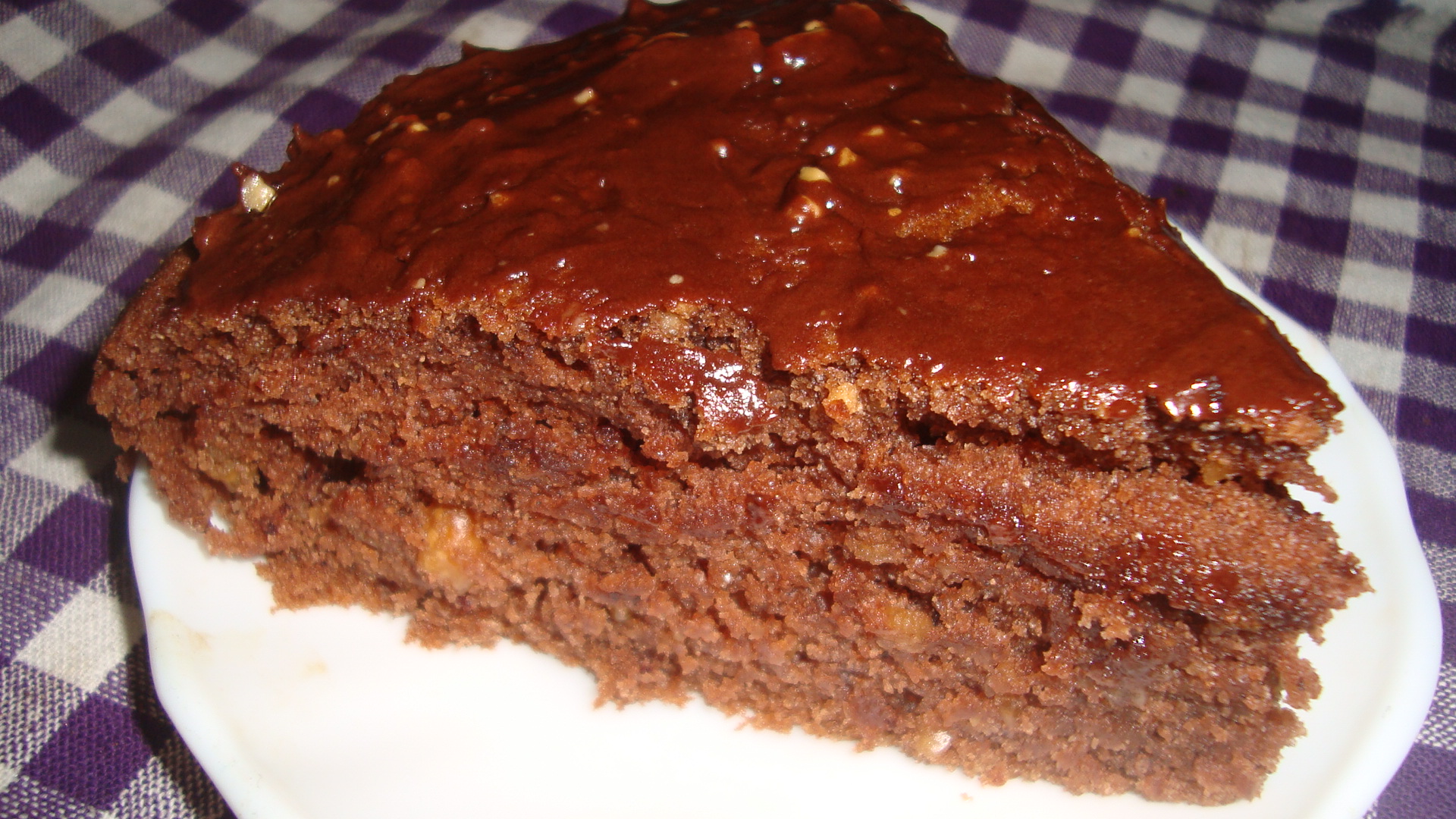
I generally like my mother’s chocolate cakes a lot. Recently, she tried out a nutty vegan version of her chocolate cake which came out really delicious. Here is my mother’s recipe for the yummy cake.

Peanut Chocolate Cake

Time taken: 50 mins

Serves 8 to 10

Peanut chocolate cake

Ingredients:

  • Vegetable oil margarine – ¾ cup + 1 tbsp (for frosting)
  • Sugar – 1 cup
  • Banana – ½ , as an egg substitute
  • Wheat flour – 1 ½ cup
  • Soya milk – 1 cup
  • Peanut – ½ cup, coarsely ground + 2 tbsp (for frosting)
  • Vanilla – 2 tsp
  • Cocoa powder – 2 tbsp + 1 tsp (for frosting)
  • Baking powder – 1 tsp
  • Baking soda – ½ tsp
  • Icing sugar – 2 tbsp, for frosting

Method:

  1. Sift the dry ingredients – the wheat flour together with the cocoa powder, baking powder and baking soda – and keep aside.
  2. Mash the banana in a bowl. Add the margarine and sugar to the bowl and whisk them together.
  3. Gradually add the soya milk and continue whisking.
  4. Stir in the coarsely ground peanuts and vanilla essence.
  5. Slowly fold in the dry ingredients.
  6. Pour the cake batter into a greased tray and bake at 190⁰C/374⁰F for 40 mins.
  7. Whisk 1 tbsp margarine together with 1 tsp cocoa powder, 2 tbsp icing sugar and 2 tsp ground nuts to make the frosting.
  8. Spread evenly on surface of the peanut chocolate cake, after the cake has sufficiently cooled.

Recipe source: Raji Thillainathan.